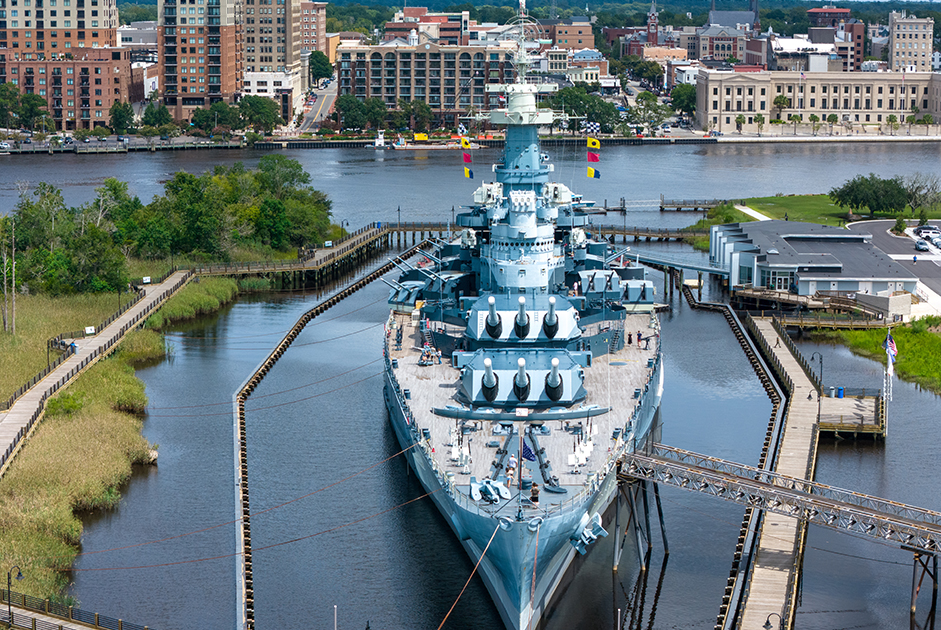
She rests quietly on the Cape Fear River, her hull a slate gray sentinel against the Wilmington skyline, the USS North Carolina (BB55), one of the most decorated American battleships of World War II. For nearly six decades, she has served not as a weapon of war but as a monument to memory, drawing visitors from across the country to walk her decks and step back into one of history’s most defining conflicts. Today, renewed attention to the surrounding environment is transforming the battleship’s home into one of North Carolina’s most compelling heritage destinations.
A Warrior’s Resume
Commissioned in April 1941, the North Carolina, nicknamed “The Showboat,” was the most powerful warship in the United States Navy at the time of her launch. Armed with nine 16-inch guns capable of hurling a 2,700-pound shell more than 20 miles, she displaced more than 35,000 tons and carried a crew of nearly 2,400 officers and enlisted men. She earned 15 battle stars during World War II, more than any other battleship in the Pacific Fleet, participating in every major naval campaign from Guadalcanal to the final strikes against the Japanese home islands.
She was struck by a Japanese torpedo in 1942, an event so catastrophic that enemy radio broadcasts prematurely declared her sunk. She was not. By 1945, the North Carolina had helped turn the tide of a war, escorting carrier task forces, providing anti-aircraft cover and delivering shore bombardment across thousands of miles of ocean.
When the war ended, she was decommissioned in 1947. In 1961, North Carolina schoolchildren raised more than $330,000 in a grassroots “Save Our Ship” campaign, pulling the battleship from a Navy scrapyard list and bringing her home to Wilmington permanently. She opened to the public in 1962 and has welcomed more than 14 million visitors since.
The Environmental Transformation
The experience of visiting the battleship has historically been defined almost entirely by what happens onboard, the gun turrets, the crew quarters and the eerie silence of compartments that once hummed with the urgency of war. But, in recent years, Battleship North Carolina has undertaken a series of environmental and infrastructure improvements designed to make the surrounding grounds as compelling as the ship herself.
The 12-acre park along the west bank of the Cape Fear has been substantially reimagined. Shoreline restoration efforts have stabilized the riverbank and improved water quality, creating a more natural buffer between the urban edge of Wilmington and the ship’s berth. Native plantings now line walking paths, providing habitat for migratory birds and pollinators while also softening the industrial aesthetic that once dominated the approach to the ship.
Interpretive trails connecting the parking areas to the ship now double as ecological education spaces, with signage explaining the tidal ecosystem of the Cape Fear River and the role waterways played in the region’s military and economic history. These changes are part of a broader effort to extend visitor dwell time, giving families and school groups reasons to linger on land before and after their shipboard tour.
Lighting upgrades have been particularly impactful for tourism. The ship is now dramatically illuminated at night, turning her into a visible landmark from the riverfront and the downtown Wilmington waterfront across the water. Evening “battle sound” light shows have become popular seasonal events, drawing visitors who might not otherwise make the trip specifically for a daytime tour.
Looking Ahead
Battleship North Carolina’s leadership has also invested in accessibility improvements, expanding paved pathways and adding interpretive kiosks designed to engage visitors of all ages before they even board the vessel. Partnerships with Wilmington’s downtown tourism corridor, including Water Street restaurants and the nearby Cape Fear Museum, are helping build multi-stop itineraries that keep visitors in the region longer.
The environmental changes reflect a broader understanding shared by heritage tourism sites nationwide – that the natural setting around a landmark is not incidental, it is part of the story. For the USS North Carolina, a ship that fought across the vast blue expanse of the Pacific, a well-tended, ecologically thoughtful riverbank feels like an appropriate homecoming.
She survived a torpedo, a scrapyard and the passage of time. Now, with renewed investment in the land beneath her keel, the “Showboat” is ready to welcome the next generation of admirers.